
Mathematical Modelling of Thermal Cracking in Metal Billets
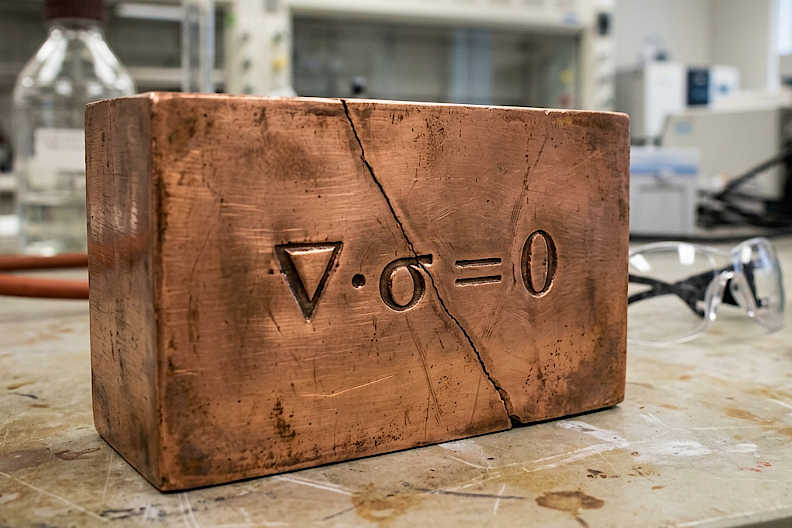
Google Gemini AI created image from the prompt "A cracked block of copper metal sits on a laboratory bench. Stamped into the block is the equation $\nabla\cdot\sigma = 0$."
Funding is available for a 4-year full-time PhD scholarship to start in October 2026. This includes home fees and a UKRI rate stipend.
I am looking for a student with an undergraduate degree in a numerate discipline (e.g. Mathematics, Physics, Engineering, etc) and a desire to use your applied mathematical modelling skills to solve real-world problems.
The Project
This PhD project would investigate using applied mathematical techniques to model thermal cracking of metal billets during heating and cooling. A real-world example is shown below:
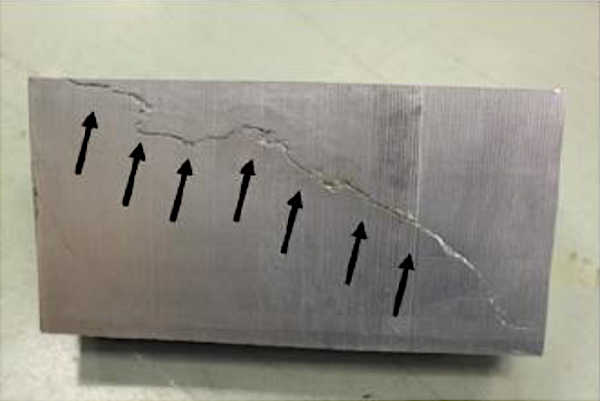
A crack in a metal ingot. Taken from figure 3 of Egole et al (2018).
The project was proposed by Copper Alloys Ltd. Copper Alloy's products are predominantly cast on-site and hot-worked, and the wide range of alloys produced and products manufactured require careful attention to heating and cooling. For example, many of their alloys exhibit a ductility trough that requires extremely slow heating and cooling to avoid failure, whilst too slow heating and cooling can negatively impact the material properties of the alloys. Better optimizing this process would allow faster heating and cooling without component failure, and would result in better alloy properties, lower energy usage, and increased throughput through better equipment utilization.
The objectives, and a very rough timetable, are:
- First 6 months. Solve the heat diffusion equation on geometrically simple shapes (e.g. rectangular, cylindrical, octagonal prism, etc) to calculate the temperature distribution through a simple metal billet during idealized heating and cooling. The rectangular and cylindrical problems are simple and classical (due to the equations being separable in these cases), but generalizing to an arbitrary polygon (e.g. an octagonal prism) is new, novel, and more challenging.
- Next 6 months. Given the temperature distribution, solve the static linear-elastic solid mechanics equations to calculate the stresses generated by thermal expansion. Since this incorporates both inhomogeneous temperatures and the specific geometry, it is difficult to guess a priori where thermal stresses will be maximized, and this work should bring insight, including into the effects of sharp corners.
- Next 6 months. Given the temperature distribution and the stresses, use a material model to predict cracking behaviour. This would be dependent on the particular material used, and would incorporate the ductility trough thought by Copper Alloys to be the cause of cracking. This would result in a first publication, and a first deliverable to Copper Alloys.
- Next 6 months. Suggest optimized billet geometries and heating and cooling strategies, and explore parameter space (for example, using different material models for different materials, both real and theoretical).
- Next 12–18 months. Relax some of the idealized assumptions and attempt to model more realistic real-world situations; for example, different types of cooling and heating, the asymmetry of the bottom, side and top surfaces, the effect of defects and imperfections, modelling the propagation as well as initiation of cracks, effects of subsequent forming or cutting of the billet, etc.
- A stretch goal (possibly a separate PhD) would be to apply the knowledge gained so far to other metal forming processes, such as for example hot rolling, using the existing group expertise of modelling rolling processes.